
Each-way betting is one of the least understood types of sports betting wagers, even among seasoned sports betting veterans, but this page should clear up any questions you have regarding the “Each-way” or “E/W” numbers you see when betting on outright winners.
In the simplest of terms, an each-way bet allows you to split your wager 50/50 between an “outright win” bet and a “to place” bet. The win portion of the bet pays out at the odds displayed if your pick does in fact win outright, while the second half of the bet pays out at a fraction of the outright winner odds, if the selection finishes within the places outlined by the sportsbook.
Rereading that paragraph and I can barely understand what I mean, so let’s get into some examples, which are far easier to explain.
Golf Winner Example
Here’s an example from Bet365 using the odds to win the 2027 Masters golf tournament. The each-way terms for the market were “Each-way 1/4 1-2-3-4-5”:
- Scottie Scheffler 4/1
- Rory McIlroy 13/2
- Jon Rahm 14/1
- Xander Schauffele 18/1
- Bryson DeChambeau 20/1
- Cameron Young 20/1
- Ludvig Aberg 20/1
- Collin Morikawa 25/1
- Matt Fitzpatrick 25/1
- Tommy Fleetwood 25/1
Notice the “Each-way 1/4 1-2-3-4-5” option. This means that if you chose to make the bet an “each-way” bet, then half of your wager would be paid out at 1/4 of the above odds if your pick finished in the top 5 places in the tournament (1-2-3-4-5).
For the purposes of this example, let’s select Tommy Fleetwood at 25/1. After selecting Fleetwood you will have the option to tick the “E/W” box on the Bet365 bet slip. When you select this option you will notice that your bet amount doubles. This is because when you select each-way you are actually making two bets. For this example let’s say you are placing one $20 bet on Fleetwood to win, and one $20 bet on Fleetwood to finish in the top 5 at 1/4 odds, which would be odds of 6.25/1 ($40 of total bets).
The $40 bet has a potential payout of $665. Let’s break that down.
- The first $20 on Fleetwood to win has a potential payout of $520 ($500 winnings at 25/1 + $20 wager).
- The second $20 bet has a potential payout of $145 ($125 winnings at 6.25/1 + $20 wager).
If Fleetwood finishes between 2nd and 5th then I will still receive the $145 payout on the each-way bet. The $20 win bet would lose, so overall I’d be up $105 on my $40.
Different Each-Way Terms
The same event can come with more than one set of each-way terms, and each one has its own odds. For the 2027 Masters, Bet365 offered “E/W 1/5 1-8” and “E/W 1/5 1-10” lines alongside the standard 1/4 1-2-3-4-5 terms. The more places a line pays, the shorter the win odds. Here’s how Tommy Fleetwood’s $20 each-way bet ($40 total) compares on each line:
| Each-Way Terms | Win Odds | Places Paid | Place Odds | Place Payout | Total If He Wins |
|---|---|---|---|---|---|
| E/W 1/4 1-2-3-4-5 | 25/1 | Top 5 | 6.25/1 | $145 | $665 |
| E/W 1/5 1-8 | 20/1 | Top 8 | 4/1 | $100 | $520 |
| E/W 1/5 1-10 | 18/1 | Top 10 | 3.6/1 | $92 | $472 |
The first fraction tells you what share of the win odds the place part pays, and the numbers after it tell you which finishing positions count as a place. Lines that pay more places come with lower win odds and a smaller fraction, so they pay less when your pick wins or finishes near the top. In exchange, they still pay out if your pick finishes further down. In this example, the 1/5 1-10 line pays $92 if Fleetwood finishes anywhere from 6th to 10th, where the standard terms would pay nothing on the place part.
Which terms are best depends on your pick. If you think a player can win, the standard terms pay the most. If you think a player will contend but probably won’t win, the extra places can be worth the lower odds.
Euro 2028 Example
Let’s quickly look at one more example, to show you how the each-way terms can be displayed differently. The outright winner market for Euro 2028 at Bet365 has each-way terms of 1/2 1-2.
- France 4/1
- Spain 4/1
- England 4/1
- Portugal 8/1
- Germany 9/1
- Netherlands 14/1
- Belgium 20/1
- Italy 20/1
- Norway 25/1
Here is a quick look at the favourites to win Euro 2028. Again, the each-way terms for the Euro 2028 outright betting at Bet365 are 1/2 1-2. This means that if you select the each-way option then half of your bet would be wagered on the team just making the Euro 2028 final and be paid out at half the above odds. For example, if you take the Netherlands at odds of 14/1 (15.00 in decimal) then half the bet would apply to the Netherlands making the final at odds of 7/1.
Here’s what that bet looks like on the Bet365 bet slip with the E/W box ticked:
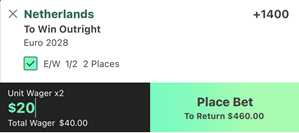
The $20 stake becomes a $40 total wager. If the Netherlands win Euro 2028, both parts pay for a total return of $460: $300 from the win bet at 14/1 and $160 from the place bet at 7/1. If they lose the final, only the place part pays, returning $160. (Bet365 showed the odds in American format here, where +1400 is the same as 14/1.)
Horse Racing Example
Each-way betting is most common in horse racing. The number of places paid usually depends on how many horses are in the race. Typical each-way terms look like this, but always check the terms shown for the race you’re betting on:
| Runners | Each-Way Terms |
|---|---|
| 2 to 4 | Win only (no each-way) |
| 5 to 7 | 1/4 odds, 1-2 |
| 8 or more | 1/5 odds, 1-2-3 |
| 12 to 15 (handicap) | 1/4 odds, 1-2-3 |
| 16 or more (handicap) | 1/4 odds, 1-2-3-4 |
For example, a $10 each-way bet ($20 total) on a horse at 10/1 in a 10-horse race with 1/5 1-2-3 terms would return $140 if the horse wins ($110 from the win bet and $30 from the place bet at 2/1). If the horse finishes 2nd or 3rd, the place bet still returns $30.
Where you live in Canada changes how you can bet each-way on horse racing at Bet365. Outside Ontario, you can bet each-way on Futures/Antepost markets for big races, as well as on Meetings. In Ontario, Bet365.ca horse racing bets go through ‘Markets’, which use pool betting, so instead of an each-way bet you would place separate win and place (or show) bets.
Each-Way Betting Tips
There are a lot of ways you can use each-way bets to your advantage when betting futures. Here are a few things to keep in mind to give yourself an edge on the sportsbook.
- Compare the each-way odds to the equivalent prop bet. You will often notice that the each-way bet has better odds than the prop bet for say a “top 5” or “to reach final” continuing with the two examples above. For example, if Fleetwood were 5/1 to finish in the top 5, the each-way bet would give you better odds of 6.25/1 for the same outcome.
- Compare the each-way terms between sportsbooks. The each-way terms do vary between sportsbooks, so pay attention to the terms and bet accordingly. For example, if a selection has odds of 25/1 at sportsbook A with each-way odds of 1/4 1-2-3-4, but odds of 22/1 with each-way odds of 1/4 1-2-3-4-5-6-7 at sportsbook B, it may still be better value to place your each-way bet at sportsbook B in order to take advantage of the extra 3 places for the payout. This is something that you can weigh the risk vs reward for yourself, but be aware of the terms.
- Check how many places are paid. The number of places can change from event to event, and bigger events like golf’s majors often pay more places than a regular tournament. Always check the each-way terms before you place your bet.
Each-Way Betting FAQ
What does E/W 1/4 1-2-3-4-5 mean?
The place part of your each-way bet pays 1/4 of the win odds if your pick finishes 1st, 2nd, 3rd, 4th or 5th. So at 20/1, the place part pays 5/1.
What happens if my each-way pick wins?
Both parts of the bet pay. A win also counts as finishing in a place, so you collect the win bet at the full odds and the place bet at the each-way fraction.
Can I lose money even if my each-way pick places?
Yes, at short odds. Take Scottie Scheffler at 4/1 for the Masters with a $20 each-way bet ($40 total) on the 1/4 1-2-3-4-5 terms. The place part pays 1/1, so if he finishes 2nd to 5th, you get $40 back and only break even. On a line with 1/5 terms, a 4/1 pick’s place part pays 4/5, so a place finish returns just $36 and you’re down $4. Each-way bets work best on picks with longer odds.
Is an each-way bet the same as a place bet?
No. A place bet only pays if your pick finishes in the places. An each-way bet is a win bet and a place bet combined, so it costs twice your stake and pays more if your pick wins.